
Orient
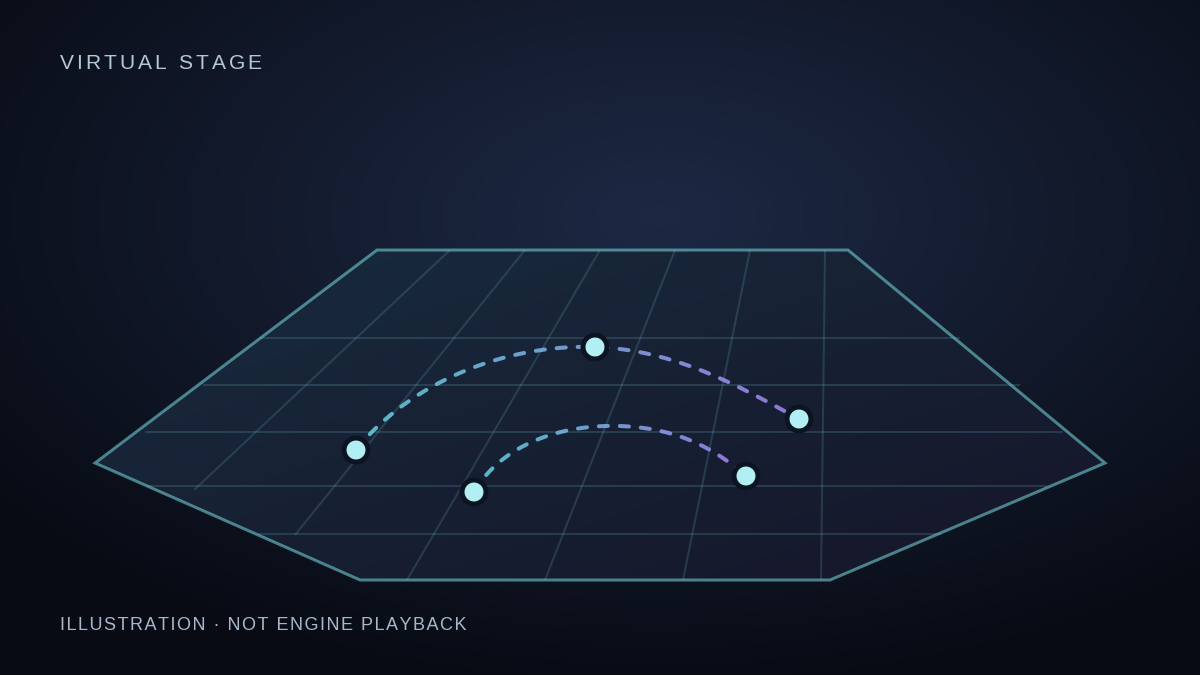
Give the space a frame of reference: its boundaries, direction and grid.
VIRTUAL STAGE / THE SPATIAL VISION
COMING SOON / CONCEPT
Imagine a personal spatial guide that helps make sense of where you are, where you belong, and what comes next.
A future idea, not an available spatial guide.
A DIFFERENT WAY TO SEE
Every place has a language: a front and a back, points that matter, and ways to move between them. We’re imagining a guide that brings those pieces into one personal view.
In a future version, a calibrated, oriented grid could help anchor a spot and a route to a real space. Real-time AR and awareness of current location are possibilities we would like to explore—not capabilities shown by this page.
Give the space a frame of reference: its boundaries, direction and grid.
Give a person, place or task a meaningful point within that frame.
Connect points with a path that makes the next movement easier to picture.
ONE IDEA / MANY WORLDS
Choose a setting to see how a space, a spot and a path might relate. These are fictional examples, not operating products.
Shown: the theater concept. Enable JavaScript to switch between fictional scenarios.
Picture a performer understanding an entrance and the mark where a scene begins.
Imagine a field visit with a specific inspection point in mind.
Imagine a player picturing a movement across a practice court.
Imagine looking at a busy exhibition hall with one destination in focus.
Imagine arriving after dark and picturing how the entrance relates to a campsite.
The diagrams are fictional. They do not show actual positioning, navigation, a customer project, or a working industry product. The selector does not use your camera or location.
THE POSSIBILITY AHEAD
Today, the examples above are diagrams. The bigger idea is a guide that could one day relate an oriented, calibrated grid to the world around you—so a chosen spot or path could be understood from your own perspective.
Future real-time AR and current-location awareness are ideas for exploration, not a promise of availability or performance. This site does not locate you for the concept.
Explore industry ideasWHERE VIRTUAL STAGE BEGINS
The broader spatial guide is a vision. The existing dance-specific experience is different: a Director for shaping choreography and a Viewer for rehearsing a dancer’s role.
Explore the dance toolsThe interactive illustration uses the real Virtual Stage engine and a showcase routine when available. It shows paths and facing—not captured body motion or a live camera feed.
The separate optional experimental dance AR panel is uncalibrated and is not the proposed spatial guide.
The five-dancer showcase uses the real Virtual Stage engine when available. It is an illustration, not a live camera feed.
The still view has no interactive controls. The live stage requires JavaScript, WebAssembly and WebGL. Once it loads, use Tab to reach its controls, arrow keys on the stage to orbit, and the buttons to choose roles and views. Or read about each part of the process.
THE DANCE EXPERIENCE
Explore the dance-specific tools, access and pilot information behind the showcase.
Shape formations, paths and cues.
EXPLORE THE DIRECTOR → 02 / VIEWER ↗See your role and practise at your own pace.
EXPLORE THE VIEWER → 03 / SOUND ↗Explore the connection between music and movement.
EXPLORE SOUND → 04 / TOGETHER ↗A closer look at the pilot being prepared.
ABOUT THE PILOT → 05 / REHEARSE ↗Start with the private invitation from your teacher.
FIND YOUR WAY IN →BEYOND THE DANCE FLOOR / PLANNING ONLY
Explore ideas for future spaces and industries. These are planning placeholders, not available products or customer projects.